How to Move a Boat Across Country: The Ultimate 2025 Guide
Moving a boat across town is a Saturday chore; moving a boat across the country is a logistical expedition. Whether you have purchased a centre console from a seller three states away or are relocating your family cruiser to a new coast, the stakes are high.
A cross-country haul involves navigating interstate regulations, managing wear and tear on your trailer, and ensuring your vessel arrives without a scratch. This guide will walk you through every mile of the journey, helping you decide between a DIY adventure and hiring professional hauliers.
The Big Decision: DIY Towing vs. Professional Hauling
Before you check your tyre pressure, you need to assess the feasibility. Towing a boat 2,000 miles is gruelling work. It puts massive strain on your towing vehicle and requires a specific skill set.
Ask yourself these three questions:
- Does your boat exceed legal width? If your boat’s beam is over 8.6 feet (102 inches), it is considered a “Wide Load” in most US states. This requires special permits for every state you enter.
- Is your trailer road-worthy for 2,000+ miles? A trailer that sits in a marina yard 360 days a year may fail catastrophically at highway speeds.
- Do you have the time? Towing a heavy load increases travel time by 25-30% due to lower speeds and more frequent fuel stops.
Comparison: DIY vs. Pro
|
Feature |
DIY Towing |
Professional Hauling |
|
Cost |
Fuel, Hotels, Wear & Tear |
Single Flat Fee (Higher upfront) |
|
Liability |
You are 100% responsible |
Carrier Insurance covers damage |
|
Effort |
High physical/mental stress |
Zero effort (Turnkey) |
|
Speed |
Slow (Safety limits) |
Faster (Professional drivers) |
Option 1: How to Tow a Boat Cross-Country Yourself
If you have the truck, the time, and the beam width under 8.6 feet, towing it yourself can be rewarding and cost-effective. However, preparation is non-negotiable.
1. Inspect the Trailer (The Weak Link)
Most cross-country disasters happen because of the trailer, not the boat.
- Bearings: Repack your wheel bearings with fresh grease. If you don’t know when they were last done, do them now. Carry a spare hub assembly.
- Tires: Check the date codes. Trailer tyres degrade from UV exposure even if the tread looks new. If they are over 5 years old, replace them. Always carry a spare (or two).
- Lights: Ensure all running lights and brake lights function. Corrosion is common in marine wiring; use dielectric grease on connections.
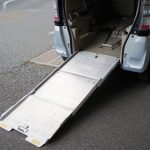
Finally, consider your loading strategy for the destination. If your new location has difficult ramp access, you might need to upgrade your setup; researching whether you can order custom-made aluminium loading ramps is a smart move to ensure you aren’t left stranded at the water’s edge.
2. Secure the Vessel
Your boat will experience hurricane-force winds (65+ mph) for days on end.
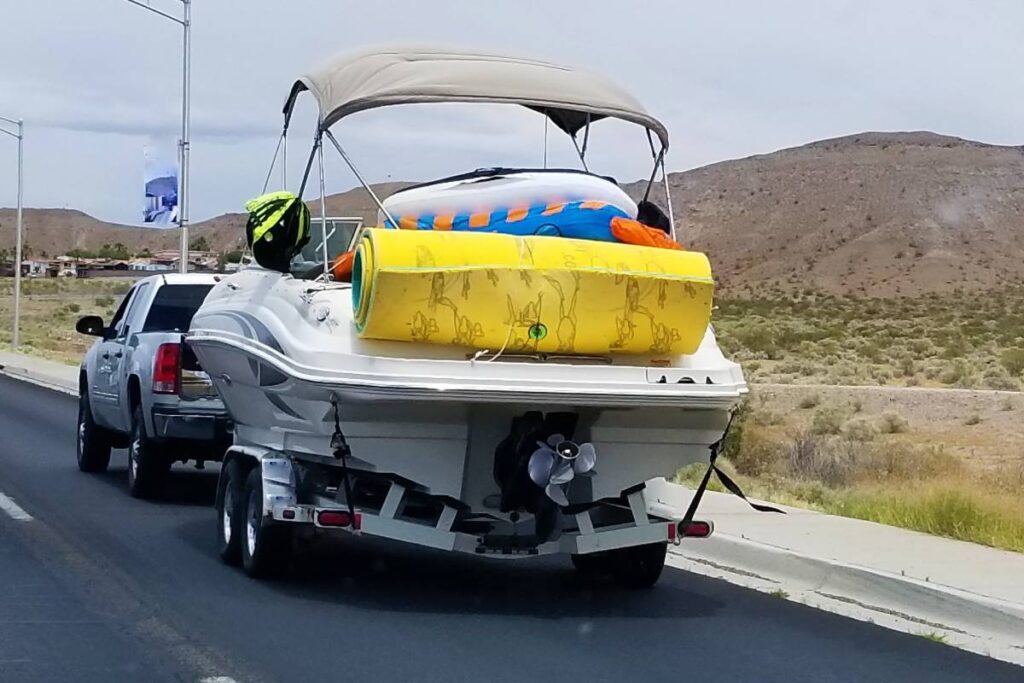
- Remove Canvas: never tow with a cockpit cover or bimini top up unless it is specifically rated for highway travel. They will shred.
- Transom Saver: Use a transom saver to support the outboard motor’s weight, preventing stress cracks on the hull during highway bumps.
- Strap Down: Use heavy-duty ratchet straps on the stern. Do not rely solely on the winch strap at the bow; add a safety chain.
Warning: Check your vehicle’s GCWR (Gross Combined Weight Rating). This is the maximum weight of your truck, passengers, cargo, and the fully loaded boat/trailer. Exceeding this is illegal and dangerous.
Option 2: Hiring a Professional Boat Transport Service
For boats over 30 feet, or for owners who value peace of mind, hiring a professional is the standard route.
Finding a Reputable Haulier
The shipping industry is filled with brokers and carriers. To protect your asset, you must verify its credentials based on your specific location.
- Check Registration: Legitimate carriers must be registered with their local Department of Transportation.
- Verify Regional Expertise: Shipping routes vary significantly by geography. For example, a US-based haulier needs specific FMCSA authority, whereas if you are shipping down under, you specifically need Interstate Boat Transport AU services that understand the unique height clearances and trailer regulations between Australian states like Queensland and Victoria.
- Ask for Insurance Certificates: Ensure they have Cargo Insurance specific to marine vessels. Ask for the specific limit (e.g., $100k, $250k). If your boat is worth $300k and they only have $100k coverage, you are underinsured.
Transport Methods
- Tow-Away: The haulier uses their truck to tow your trailer. (Cheapest, but requires your trailer to be perfect).
- Flatbed/Lowboy: The boat (and potentially the trailer) is loaded onto a semi-trailer. (Safest for long distances, reduces wear on your trailer tyres).
Understanding the Costs: What to Expect
Pricing varies wildly based on fuel costs, seasonality, and route popularity.
- Professional Average: Expect to pay between $2.00 and $3.75 per mile for boats under 10 feet wide.
- Oversized Loads: If the boat is over 12 feet wide, costs can skyrocket to $4.00 – $6.00+ per mile due to the requirement for escort vehicles and complex permitting.
- DIY Costs: Don’t underestimate fuel. Towing a boat can drop a truck’s fuel economy to 8-10 MPG. Calculate: (Total Miles / 9 MPG) * Gas Price + Hotels + Food + Emergency Fund.
The Essential Preparation Checklist
Regardless of who moves the boat, the “Make Ready” process is the owner’s responsibility.
1. Shrink Wrapping
For cross-country moves, professional shrink wrapping is highly recommended. It protects the gel coat from road debris, stone chips, and exhaust soot. Ensure the wrapper installs vents to prevent mould.
2. Interior Security
Remove all loose items. Electronics, cushions, fishing gear, and personal items should be stowed in your vehicle or locked securely in cabins. The vibration of the road will turn loose items into projectiles inside the cabin.
3. Fluid Management
- Fuel: Reduce fuel to 1/4 tank. This lowers the weight significantly (gas weighs roughly 6 lbs per gallon) but leaves enough for maneuvering.
- Water: Empty all fresh water and holding tanks.
- Batteries: Disconnect battery switches to prevent dead batteries upon arrival.
For diesel truck owners, ensure your DEF tank is topped off before you leave. Highway prices can be exorbitant, so knowing how much AdBlue is per litre and stocking up in bulk beforehand can save you significant cash during the trip.
4. Documentation
Carry your registration, proof of ownership, and insurance policies. If hiring a pro, provide them with a copy of the Bill of Lading before they depart.
FAQ
Q: Can I load my boat with household goods to save on moving costs?
A: No. Professional hauliers are legally restricted by weight and cargo type. They are licensed to haul boats, not household goods. Putting furniture inside the boat can void their insurance and result in heavy fines at weigh stations.
Q: What happens if my boat is damaged during transport?
A: If you hired a pro, note the damage on the Bill of Lading before signing off on delivery. Take photos immediately. File a claim with their insurance carrier.
Q: Do I need a wide-load permit for a standard pontoon boat?
A: It depends. Many modern pontoons are 8.5 feet wide, which is legal. However, some are 8’6″ or wider. Measure the widest point (including rub rails). If it exceeds 102 inches, you need permits for each state.
Conclusion
Moving a boat across the country is a significant project that demands respect for physics and logistics. Whether you choose the independence of a DIY tow or the convenience of a professional haulier, success lies in the preparation.
Inspect your equipment, verify your insurance, and plan your route carefully. With the right strategy, you’ll be launching in new waters before you know it.